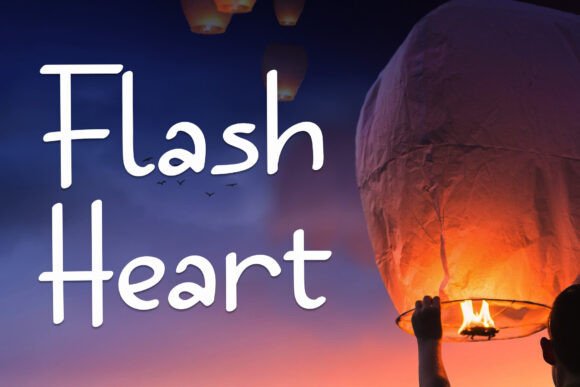
Flash Heart: A Handwritten Font for Creative Design
Flash Heart is a unique and elegant font that brings a handwritten touch to a wide range of design projects. Its natural, hand-made appearance makes it ideal for applications where a personal, artistic feel is desired. Whether you're designing wedding invitations, greeting cards, billboards, logos, or business cards, Flash Heart offers a distinctive visual identity that can elevate your creative work.
What Makes Flash Heart Unique?
Flash Heart stands out due to its varied baseline and organic, handwritten style. Unlike traditional fonts that follow strict alignment rules, this font mimics the irregularity and fluidity of real handwriting. This variation in baseline adds character and authenticity, making each letter appear slightly different while maintaining readability.
The font is crafted with attention to detail, featuring subtle curves and natural strokes that reflect the imperfections of hand-drawn typography. These elements contribute to its charm and make it particularly well-suited for designs that aim to convey warmth, emotion, or a personal connection.
Why Would Someone Be Interested in Flash Heart?
Designers and creators often seek fonts that can add personality and visual interest to their projects. Flash Heart appeals to those who want to move beyond standard sans-serif or serif fonts and introduce a more expressive, artistic element into their work.
Its versatility allows it to be used in various contexts, from small-scale print materials like greeting cards to larger-format displays such as billboards or signage. The font's ability to blend elegance with a casual, handwritten aesthetic makes it an attractive option for both professional and personal projects.
Benefits of Using Flash Heart
One of the primary benefits of Flash Heart is its ability to create a strong visual impact. The font’s unique style can help a design stand out and capture attention, especially in competitive environments like advertising or event branding.
Additionally, the font is PUA encoded, which means users can access all glyphs and swashes with ease. This feature is particularly useful for designers who want to customize their text with special characters or decorative elements, enhancing the overall design without compromising readability.
Another advantage is its adaptability. Whether used in digital or print formats, Flash Heart maintains its quality and legibility, making it a reliable choice for a variety of media.
Considerations and Tradeoffs
While Flash Heart offers many benefits, there are some considerations to keep in mind. Because of its handwritten nature, the font may not be suitable for all design contexts. For example, in situations requiring high precision or formal presentation, a more structured font might be a better fit.
Additionally, the font's irregular baseline can affect alignment when used in large bodies of text. This may require extra effort in layout design to ensure consistency and readability. Users should also be aware that the font may not render perfectly on all platforms or devices, especially if they are not using a supported format.
When Is Flash Heart a Strong Fit?
Flash Heart excels in scenarios where a personal, artistic touch is needed. It is particularly well-suited for:
- Wedding invitations – Adding a romantic and heartfelt feel to wedding-related materials.
- Greeting cards – Creating a warm, handwritten look that conveys genuine emotion.
- Logos and branding – Offering a unique visual identity that sets a brand apart.
- Billboards and signage – Drawing attention with its eye-catching design.
- Business cards – Giving a creative edge to personal or company branding.
In these cases, the font’s natural, hand-made style enhances the message and creates a stronger emotional connection with the audience.
When Might Alternatives Be Worth Considering?
While Flash Heart is a great choice for many projects, there are situations where alternatives may be more appropriate. For instance:
- Formal documents – Where a clean, professional font is preferred.
- Technical or informational content – Where clarity and consistency are paramount.
- Large-scale print jobs – Where uniformity across all text elements is essential.
- Digital platforms with limited font support – Where compatibility is a concern.
In these cases, designers may want to consider other fonts that offer greater consistency, scalability, or compatibility with specific design requirements.
Practical Decision-Making Insights
When deciding whether to use Flash Heart, it's important to evaluate the purpose and context of your design. Ask yourself: Does this font align with the message I want to convey? Will it enhance the visual appeal without compromising readability?
Also, consider the platform or medium where the font will be used. If you're designing for print, ensure that the font is available in a supported format. If you're working digitally, test the font across different devices to confirm its performance.
Finally, don’t hesitate to explore alternatives if the font doesn’t meet your needs. There are many fonts available that cater to different styles and purposes, so finding the right one depends on understanding what you’re trying to achieve.
Ultimately, Flash Heart is a powerful tool for designers looking to infuse creativity and personality into their work. With its unique style, practical features, and wide range of applications, it can be a valuable addition to any designer’s toolkit.